
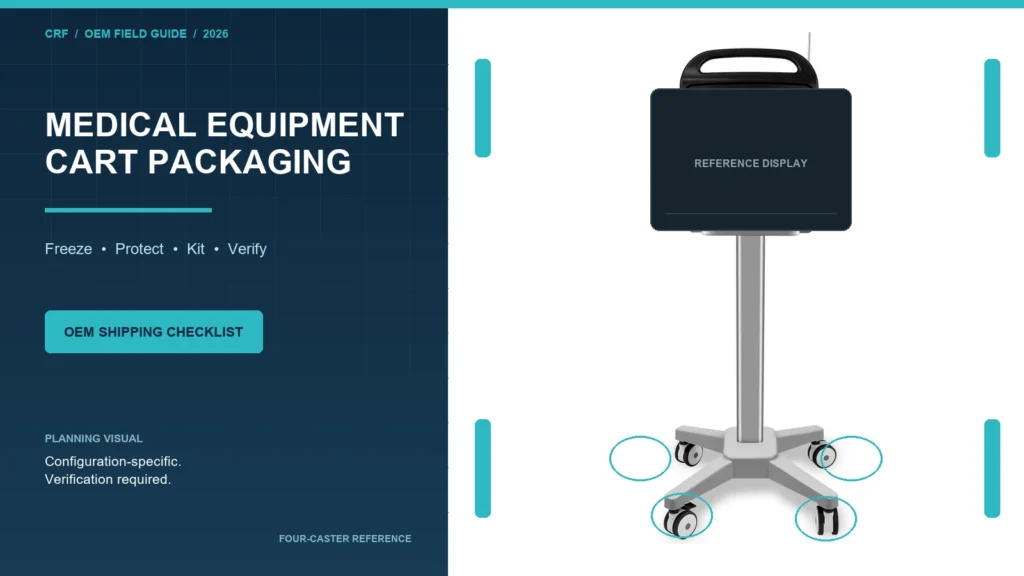
A medical equipment cart packaging plan should begin before the cart design is frozen. The package must protect the approved cart configuration, keep loose components identifiable, support the intended handling route and make destination assembly unambiguous. Buyers should define whether the cart ships assembled, partly assembled or knocked down, then evaluate a representative packed unit against project-specific acceptance criteria.
CRF’s core business is custom aluminum alloy medical equipment carts with three-, four- and five-caster bases. This guide concerns equipment-support carts, not patient walkers. It provides B2B procurement education rather than packaging-engineering, logistics, safety or regulatory advice. Qualified project parties must specify and verify the actual package and shipping program.
Why packaging belongs in the cart specification
A cart can pass a prototype review and still arrive with a scratched tray, stressed caster, displaced accessory or unidentified hardware. Packaging decisions can also change the commercial and operational scope:
- a fully assembled cart occupies more shipment volume but reduces site assembly;
- partial disassembly can protect projecting parts but transfers assembly work to another party;
- a knocked-down configuration may reduce volume but increases identification, instruction and verification needs;
- a mounted device can change mass distribution and protection requirements;
- a battery, powered lift or other regulated component can change carrier, documentation and handling requirements; and
- disposable packaging, returnable packaging and destination waste rules can lead to different designs.
Packaging is therefore a configuration-controlled subsystem, not a generic carton selected after production.
Freeze the shipping configuration
Start with one named shipping state and drawing revision. Identify every component that is:
- installed on the cart;
- removed and packed beside it;
- supplied in a separate carton or kit;
- supplied by the buyer at the destination;
- retained in a drawer, basket or holder; and
- excluded from the shipment.
Record the cart base, casters, column, tray, handle, mounts, baskets, drawers, cables, fasteners, labels and accessories. If optional equipment creates genuinely different packed states, control each variant separately instead of describing a fictional combination.
Decide who integrates the device
State whether the buyer’s medical equipment ships already mounted, in the same package but uninstalled, or through a separate supply chain. A cart manufacturer cannot design reliable device protection from a photo or an approximate weight. The responsible package designer needs controlled dimensions, mass, center-of-gravity inputs, sensitive zones, permitted contact areas and manufacturer handling instructions.
Define destination work
List every task required after opening the package. Examples include attaching casters, installing a handle, fastening a tray, mounting equipment, routing cables or fitting accessories. Assign each task to a named party and provide the approved instructions, tools, fasteners and verification record. Do not transfer an engineering decision to an installer through an incomplete instruction sheet.
Compare three shipping states
| Shipping state | Why a buyer may consider it | Information to control | Main review concerns |
|---|---|---|---|
| Fully assembled | Minimize site assembly and preserve a factory-built configuration | Complete loaded state, immobilization points, package envelope and unloading method | Shipment volume, restraint, exposed projections, caster/base loading and destination access |
| Partly assembled | Protect removable arms, trays, handles or accessories | Removed-part list, labeled kits, assembly sequence and post-assembly checks | Missing parts, wrong fasteners, cable errors and uncontrolled reassembly |
| Knocked down | Reduce packed volume or support distribution assembly | Complete BOM, part identity, fixtures, instructions and qualified assembly scope | Assembly variability, finish damage, alignment and configuration verification |
No state is universally best. Select it from product sensitivity, route, quantity, destination capability, cost model and responsible-party agreement.
Map vulnerable zones and restraint points
Casters and base
Casters can experience loads and impacts that differ from normal rolling use while a packaged cart is lifted, dropped, tilted or restrained. Define whether the base rests on its wheels, is supported elsewhere or has each caster immobilized. Any suspension, block, strap or insert must contact approved areas and should not create an unsupported claim about transport performance.
A three-, four- or five-caster base needs its own package layout. Wheel count alone does not determine protection. Base dimensions, caster projection, loaded center of gravity, column height, upper equipment and shipping orientation all matter.
Column, tray and mounting interfaces
Protect finished surfaces and projecting edges without pressing on controls, connectors or adjustment mechanisms. Identify which surfaces may carry packaging loads and which must remain clear. Mounting plates, knobs and handles may need separate cavities or protective spacing rather than pressure from a generic foam block.
Accessories, cables and fasteners
Use controlled kits for removable parts. Label the kit to the applicable model or configuration and reconcile it with the packing list. Retain cables so connectors are not loaded and loose loops cannot abrade finished surfaces. Separate hardware where mixing similar fasteners could create an incorrect assembly.
Finish and cleanliness
Specify protection compatible with the approved aluminum finish and the expected storage and transport conditions. Films, tapes, bags, foam and printed materials should be assessed for residue, abrasion, moisture behavior and destination handling. A clean-looking sample does not establish long-term material compatibility.
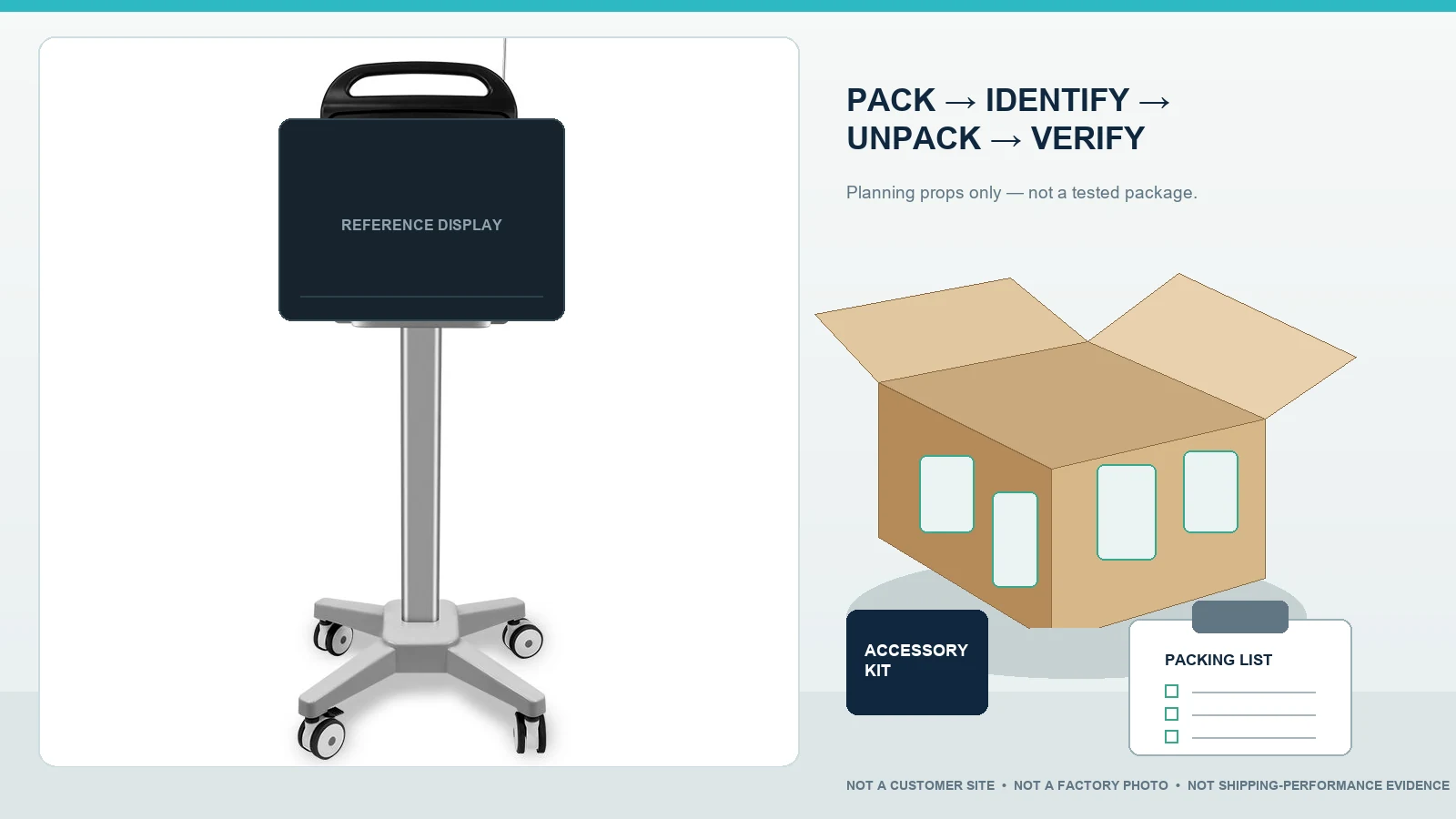
Connect the package to the logistics route
Packaging inputs should include:
- shipping mode and expected transfer points;
- package quantity and pallet pattern;
- maximum packed dimensions and mass;
- lifting, pallet-jack or forklift interfaces, if applicable;
- stacking restrictions and storage orientation;
- expected environmental conditions supplied by responsible logistics parties;
- destination doorway, dock, elevator and unpacking-space constraints;
- waste, recycling or returnable-package requirements; and
- customs, labels and documents assigned by market and responsible organization.
Do not copy generic drop, vibration, compression, humidity or temperature values into the specification. The responsible team should choose applicable verification methods and severity from the actual distribution environment and regulatory framework.
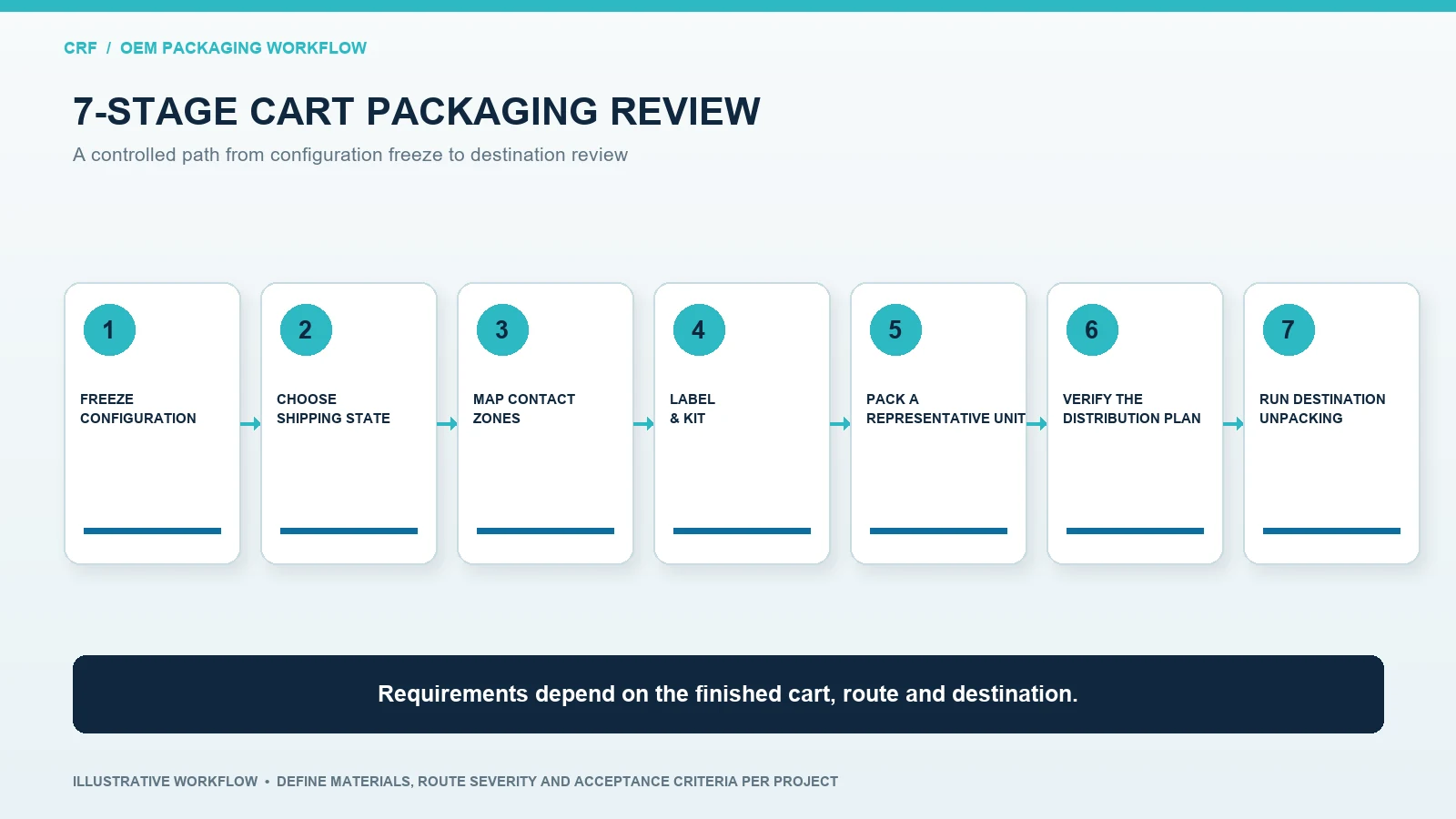
A seven-stage packaging review
1. Freeze the cart and shipment scope
Approve the exact cart revision, device state, accessory schedule and destination responsibilities. Resolve whether electrical or regulated components are included.
2. Choose the shipping state
Compare assembled, partly assembled and knocked-down options using package volume, protection, assembly capability and configuration-control needs.
3. Mark protected and permitted-contact zones
On controlled drawings, identify fragile projections, finished surfaces, connectors, adjustment controls, casters, approved supports and restraint points.
4. Design identification and kitting
Define carton, accessory, fastener and document labels. Make each kit traceable to the configuration without inventing regulatory or device labels outside the responsible party’s scope.
5. Build a representative packed sample
Use the approved cart and representative included components. Follow the intended packing instructions and record materials, dimensions, mass, orientation and closure method.
6. Verify the selected distribution plan
Qualified parties should define and perform the relevant handling and transport evaluation. Inspect the cart, accessories, finish, fasteners and documentation after evaluation against predefined acceptance criteria.
7. Run destination unpacking and assembly
Ask the intended receiving or integration team to follow the controlled instructions. Record missing tools, ambiguous labels, difficult lifts, incorrect sequences and final-configuration checks. Feed approved corrections back into drawings, BOMs and work instructions.
OEM packaging RFQ checklist
Send the cart manufacturer:
- cart model, drawing and revision;
- device and accessory shipping state;
- approved dimensions, mass and center-of-gravity inputs;
- intended shipment quantity and destination markets;
- shipping mode and logistics constraints;
- fully assembled, partly assembled or knocked-down preference;
- sensitive zones and permitted support/restraint areas;
- finish-protection and cleanliness requirements;
- removed-part, cable and fastener kitting plan;
- required package and part identification;
- pallet, carton, crate or returnable-package constraints;
- destination route and unpacking-space constraints;
- assembly responsibilities, instructions and tools;
- post-assembly inspection requirements;
- packaging-verification owner and acceptance plan; and
- documentation, photo, revision and change-control requirements.
Ask the quotation to separate the cart, packaging materials, engineering, tooling, verification, freight and destination services. Record exclusions rather than assuming they are included.
CRF references for packaging discussion
The CRF 4-Wheel Universal Ultrasound/ECG Medical Cart is an aluminum equipment-support reference. Its public page states that suitability must be reviewed against the specific device dimensions, mounting interface, equipment weight and cable routing. Those inputs also affect how the configured cart can be restrained, protected and unpacked.
The CRF Five-Wheel Medical Monitor Cart is a separate product reference. Neither page proves a packaging method, shipping performance or destination suitability. Browse the CRF medical cart collection and provide a configuration-specific shipment package for review.
Limits of this guide
This article states no universal package material, foam density, carton grade, crate construction, drop height, vibration profile, stacking load, storage period, environmental range, shipping classification, damage rate, certification, price, stock or lead time. It does not establish sterile packaging or a medical-device packaging claim. Requirements depend on the finished configuration, distribution route, destination market and decisions of qualified responsible parties.
FAQ
Should a medical equipment cart ship fully assembled?
Not always. Full assembly can reduce destination work, while partial disassembly can protect projections or reduce package volume. Compare protection, logistics, site capability and configuration-control needs for the actual cart.
Can the cart rest on its casters inside the package?
That decision requires a project-specific package design and verification. Cart mass, caster design, base geometry, restraint method, shipping orientation and distribution hazards all matter. Do not assume normal floor use represents transit loading.
What should be included with a partly assembled cart?
Provide controlled part and hardware kits, identification, approved assembly instructions, required tools or tool specifications, and a post-assembly inspection record. The exact content depends on the configuration and assigned responsibilities.
Is packaging verification the same as cart testing?
No. Packaging evaluation addresses the defined distribution system, while cart verification addresses requirements for the finished cart. Damage or configuration changes after transit may require both unpacking inspection and relevant finished-system checks.
Discuss an OEM cart shipping configuration with CRF
Explore CRF’s aluminum medical equipment carts and submit an RFQ through the contact page or a relevant product page, or email info@szcrftech.com. Include the cart/device drawing package, shipment state, destination, route constraints, accessory list, assembly responsibility and packaging acceptance plan. CRF can review the mechanical cart and packaging scope and identify missing inputs before quotation or sample work.