
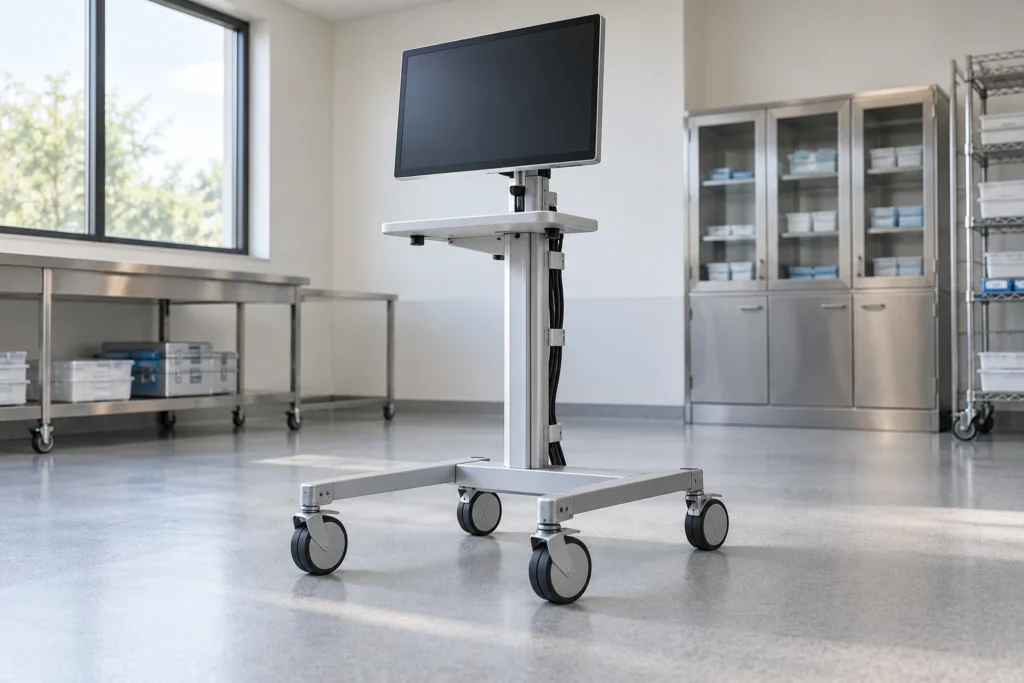

Choosing a four-wheel or five-wheel medical cart base should begin with the complete cart configuration, equipment center of mass, movement route, parking space and acceptance method. Wheel count alone does not establish stability, maneuverability, load capacity or clinical suitability. Buyers should compare controlled drawings and representative samples of the exact assemblies.
CRF’s live catalog provides real examples for this review: the CA13Z120 listing describes a four-wheel patient monitor cart, while the CA15Z052 listing describes a five-wheel medical monitor cart. They confirm that CRF supplies both base directions. They do not create a universal performance ranking, and their legacy product-page statements should not be transferred to a new order without configuration-specific verification.

Start With the Complete System, Not an Empty Base
A base is only one part of the cart. Before comparing wheel patterns, freeze the proposed assembly:
- exact device models, dimensions and masses;
- mounting interfaces and device positions;
- work surface, shelves, baskets, drawers and handles;
- monitor arms, poles and accessories;
- batteries, chargers or power components, if included;
- cable routes and service loops;
- height-adjustment or articulation states; and
- parts supplied by CRF, the buyer and other integrators.
The same base can behave differently after a monitor arm is extended, a drawer is opened or equipment is mounted above the work surface. Request evaluation in every approved operating state.
Compare the Geometry That Wheel Count Does Not Describe
“Four-wheel” and “five-wheel” are labels, not complete specifications. Ask for a drawing that records:
| Geometry input | What to confirm | Procurement reason |
|---|---|---|
| Overall footprint | Maximum width and length | Doorway, parking and bedside clearance |
| Leg pattern | Shape, angle and spacing | Approach and collision review |
| Caster centers | Controlled center locations | Turning and obstacle interaction |
| Caster envelope | Fork and wheel sweep | Pedal, cable and toe clearance |
| Column position | Offset from base center | Equipment-layout review |
| Lowest clearance | Under-base envelope | Threshold and floor-obstacle review |
| Accessory overhang | Maximum projection in each state | Complete operating envelope |
Two bases with the same wheel count may have different footprints, leg angles, caster offsets and column positions. Compare the actual geometry rather than assuming equivalent behavior.
Four-Wheel Medical Cart Base: Questions to Review
A four-wheel layout can be appropriate when its footprint, equipment package and route satisfy the buyer’s controlled requirements. Review:
- whether all four caster contact locations remain clear of accessories and cables;
- how the rectangular or cross-shaped footprint approaches the target equipment or bed;
- whether brakes are accessible in parked positions;
- how the base turns through the representative route;
- whether the configured center of mass remains inside the buyer-approved evaluation conditions; and
- whether any extended monitor, shelf or handle changes the acceptance result.
Do not describe a four-wheel base as inherently more compact or easier to maneuver. Those outcomes depend on dimensions, caster design and the complete assembly.
Five-Wheel Medical Cart Base: Questions to Review
A five-wheel pattern adds another leg and caster position, but that fact alone does not prove greater stability or safety. Review:
- radial leg spacing and complete footprint;
- column and device position relative to the base;
- caster and brake access between adjacent legs;
- cable clearance from all five caster sweeps;
- turning behavior in narrow route segments;
- approach to walls, beds, equipment and parking points; and
- service access to fasteners, covers and replaceable casters.
A five-leg base may have a different approach envelope from a four-wheel base. Measure the intended workspace and test the exact configured sample.
Specify Casters Separately From the Base Pattern
Wheel count does not define caster performance. The RFQ should identify required caster inputs without inventing values:
- wheel diameter and tread requirement;
- swivel or directional behavior;
- brake type and which casters are braked;
- mounting interface and replaceability;
- floor surfaces and transitions;
- cleaning agents and process;
- noise or rolling evaluation method, if required; and
- evidence and sample criteria for the destination market.
Avoid unsupported labels such as “silent,” “medical grade” or “heavy duty.” Translate each desired outcome into a measurable buyer-approved requirement and method.
Map the Real Route
Create a route survey from storage to every intended work point. Record:
Doorways and turns
Measure clear openings after handles, guards and door hardware are considered. Include tight turns before and after each doorway.
Thresholds and floor transitions
Identify gaps, joints, elevator entries, ramps and surface changes. A catalog image cannot demonstrate traversal of a specific route.
Bedside or equipment approach
Measure the space occupied by beds, stands, cables and other mobile equipment. Review whether the base can approach without the casters, legs or accessories colliding.
Parking and brake access
Confirm the complete cart fits its parking location and that the approved operator can access the required brakes without unsafe reaching or obstruction.
Review Center of Mass Through Every State
Provide the mass and location of every device and accessory. The integrator should review the complete assembly in its approved states, including:
- monitor arm centered and extended;
- drawer or tray closed and open;
- column at permitted positions;
- printer, computer or battery installed;
- accessories loaded as defined by the buyer; and
- cart moving and parked under the agreed method.
Never use a base-only load figure as proof for the completed cart. A rating, where supplied, must identify the covered configuration, method and limitations.
Cable, Pedal and Foot Clearance
Each caster sweeps an area during turning. Cable loops, brake pedals and low accessories must stay outside uncontrolled contact zones. On the representative sample, inspect:
- cable droop near every wheel;
- connectors or power components mounted below the work surface;
- brake-pedal access;
- pinch or strike points around leg junctions;
- accessory overhang into the operator path; and
- clearance during turns, parking and service.
Cable retention should be designed from the approved motion map, not added after the sample is built.
Cleaning and Maintenance Access
Provide the intended cleaning agents and process. Review access around leg junctions, caster forks, brakes, covers and column interfaces. Confirm how casters are inspected, removed and replaced, and whether service tools can reach the necessary fasteners.
The responsible healthcare organization must approve cleaning and infection-control practices. Neither wheel count nor an open-base appearance establishes cleanability.
Sample Comparison Plan
Whenever possible, compare representative configured samples under one controlled method.
Identity and configuration
- Product model, revision and drawings match the sample.
- Devices, mounts, accessories and cables match the approved list.
- Caster and brake specifications are recorded.
Fit and route
- Overall envelope fits measured doors, turns, work points and parking.
- Caster sweeps do not conflict with cables or accessories.
- The cart follows the representative route under the buyer’s method.
Operating states
- Every approved arm, shelf, drawer and height state is reviewed.
- Brake controls remain accessible as specified.
- Service and cleaning points can be reached.
Evidence and change control
- Required reports apply to the exact configuration.
- Deviations are documented and resolved.
- Device, caster or accessory substitutions trigger review.
The result belongs to the tested configuration and method; it should not be generalized to every four- or five-wheel cart.
RFQ Checklist
Send CRF:
- Device and accessory schedule with masses and center locations.
- Required mounts, shelves, drawers, handles and cables.
- Preferred base direction, if any, and the reason.
- Maximum footprint and approach constraints.
- Doorway, turn, threshold, floor and parking measurements.
- Required caster and brake behavior.
- Approved operating and adjustment states.
- Cleaning and maintenance process.
- Destination market and required evidence.
- Drawings, prototype quantity and forecast.
- Side-by-side sample methods and pass/fail criteria.
- Approval owners and change-control process.
Common Selection Mistakes
Treating five wheels as automatic proof of stability
Stability depends on complete geometry, center of mass, operating state and evaluation method. Ask for configuration-specific evidence.
Treating four wheels as automatically more maneuverable
Turning behavior depends on footprint, caster centers, wheel design and route. Test the exact cart.
Comparing empty carts
Mounted devices and extended accessories can materially change the system. Compare complete representative assemblies.
Ignoring caster specification
Wheel count cannot substitute for caster diameter, tread, brake, mounting and floor requirements.
FAQ
Is a five-wheel medical cart always more stable than a four-wheel cart?
No. Wheel count alone cannot establish stability. Compare complete geometry, center of mass, operating states and configuration-specific evidence.
Is a four-wheel base always smaller?
No. Overall footprint and caster sweep depend on the actual design. Use controlled dimensions rather than the wheel-count label.
Can the same base support different medical devices?
Possibly, but every device changes interfaces, mass distribution, cables and operating envelopes. Each configuration requires review and sample acceptance.
What route information should be supplied?
Provide door openings, turns, thresholds, floor transitions, work-point clearances, parking dimensions and any route obstacles.
Does CRF offer both base configurations?
CRF’s live catalog includes four-wheel and five-wheel monitor-cart listings. Final availability and suitability must be confirmed against the requested configuration and quotation.
Request a Base-Configuration Review
Send CRF the complete device schedule, mass locations, route survey, footprint limit, caster requirements and acceptance plan. CRF can compare appropriate four-wheel and five-wheel directions for a configuration-specific RFQ.
Related Resources
Request a B2B RFQ — share the exact equipment configuration and sample acceptance criteria.
This is mechanical procurement education, not clinical, electrical or engineering approval. Illustrations are generic concepts, not tested configurations.