
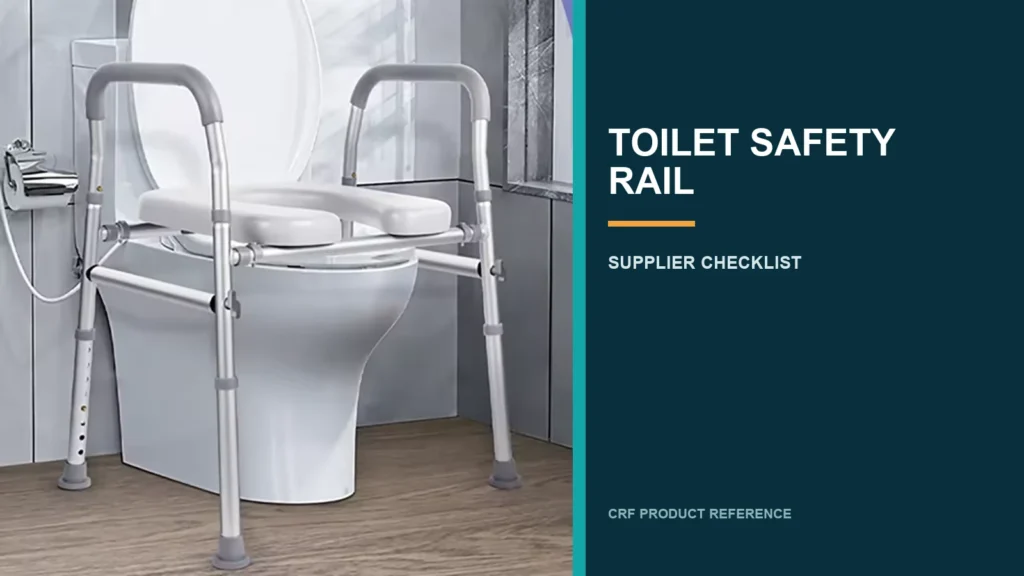
A toilet safety rail should be sourced by matching the exact rail type to the toilet, bathroom layout, user workflow and local project requirements. Buyers should verify whether the product is freestanding, seat-mounted, floor-contacting or wall-mounted; document all adjustment and contact points; inspect grip and cleaning details; and approve a representative sample. CRF’s referenced product is an adjustable toilet safety rail, not proof that one rail fits every toilet or accessible-bathroom project.
First Separate Toilet Rails From Wall-Mounted Grab Bars
“Grab bar,” “toilet rail,” “toilet safety frame” and “support rail” are often used loosely, but they can describe different structures. That distinction changes the installation interface, clearance check and validation plan.
Freestanding or floor-contacting toilet safety rail
This structure typically uses a frame around or beside the toilet and transfers force through its feet or base. Buyers need to review floor contact, frame width, toilet clearance, approach space and the risk of interference with nearby fixtures.
Seat-mounted or toilet-mounted rail
This type attaches through a defined toilet or seat interface. Buyers must confirm the bolt pattern, bracket geometry, fasteners, toilet shape and installation instructions.
Wall-mounted grab bar
A wall-mounted bar depends on the wall assembly, backing, fasteners, installation height and local accessibility requirements. It should not be substituted by assumption for a portable or toilet-mounted frame.
CRF’s current reference product is presented as an adjustable toilet safety rail. Its exact dimensions, interface, included parts and project suitability must be confirmed in the quotation and sample documents.
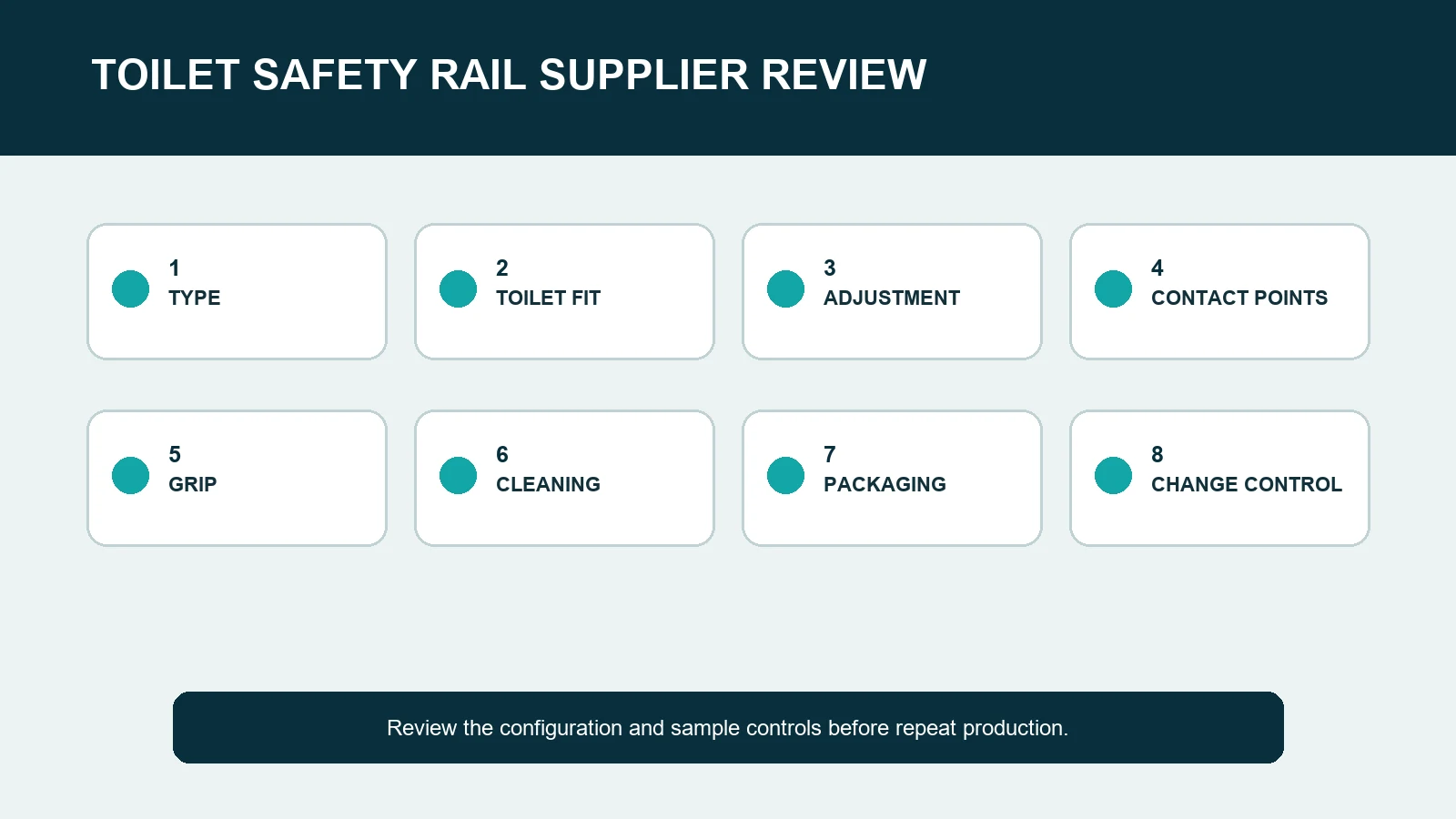
Eight Checks for a Toilet Safety Rail Supplier
1. Freeze the product type and variant
Start the RFQ with a drawing or marked photograph of the required structure. State whether the frame is freestanding, attached to the toilet, wall-mounted or another defined design. If multiple variants are requested, assign a separate item code and drawing to each one.
Avoid approving a family name alone. A change from floor-contacting feet to a mounting bracket, or from fixed to adjustable geometry, can alter installation and use.
2. Document the toilet and room interface
Provide the toilet manufacturer and model where available, plus measurements and photographs of the installation area. Record:
- bowl and seat geometry;
- seat-bolt locations if relevant;
- overall available width and depth;
- wall, partition and vanity clearances;
- floor surface and transitions;
- door swing and approach route;
- nearby dispensers, pipes and controls;
- cleaning access around the toilet.
A claim such as “fits most toilets” should not replace a fit check for the buyer’s target installation.
3. Control adjustment points
For an adjustable toilet safety rail, document every adjustable dimension, the permitted range, increment or locking method and the tools needed. The sample review should confirm that both sides can be set consistently and that the locking features are fully engaged.
Ask how the supplier prevents parts from being assembled in an unintended orientation. Clear markings and instructions can reduce configuration errors, but their content still needs approval.
4. Inspect feet, brackets and contact surfaces
Floor-contacting feet should be reviewed on representative destination surfaces. Toilet-mounted brackets should be checked against the actual mounting interface. Wall-mounted products require a separate review of substrate and anchors.
Do not infer slip resistance, structural capacity or installation suitability from a rubber-looking foot or metal bracket. Request the relevant documented evidence and define project-specific acceptance checks.
5. Review grip geometry and hand-contact areas
Check the grip position, usable length, surface, diameter or section, edge condition and clearance for the intended workflow. If padded or coated grips are requested, review their attachment, seam, cleaning process and replacement expectations.
A comfortable appearance is not sufficient evidence of ergonomics for every user. The responsible buyer should evaluate the representative configuration with appropriate professional input where required.
6. Evaluate cleaning and moisture exposure
Bathrooms introduce moisture, cleaning chemicals and contamination risks. Review tubes, fasteners, adjustment holes, caps, grips, feet and joints for cleaning access and trapped-water risks.
Request material and finish information for the exact configuration, then compare it with the destination’s cleaning procedure. Do not assume a specific alloy grade, corrosion resistance or disinfectant compatibility unless the supplier documents it.
7. Approve packaging and instructions
A sourcing decision includes more than the assembled frame. Check the delivered-parts list, protective packaging, fastener packs, labels, assembly instructions, warnings and traceability marks.
Perform a pack-out trial: open a production-representative carton, identify every component, assemble the product using the supplied instructions and record missing, ambiguous or easily damaged items.
8. Establish change control
The approved sample should have a revision-controlled drawing, component list, photos, packaging specification and signed deviations. Require notification before changes to tubing, fasteners, feet, grips, adjustment hardware, finish, dimensions, labels, instructions or packaging.
A visually similar substitute is not automatically equivalent. Re-review any change that affects fit, installation, contact surfaces, cleaning or the intended workflow.
Supplier Comparison Table
Use the same evidence request for every shortlisted supplier.
| Evaluation area | Evidence to request | Sample check |
|---|---|---|
| Product identity | Model, variant and revision | Matches label and drawing |
| Installation type | Interface drawing and instructions | Fits the target toilet or environment |
| Adjustment | Range and locking details | Sets consistently; locks engage |
| Contact points | Feet, bracket or anchor details | No unintended interference |
| Materials and finish | Configuration-specific declaration | Matches approved sample appearance |
| Cleaning | Documented care instructions | All relevant areas remain accessible |
| Packaging | Pack list and carton specification | Complete, protected and identifiable |
| Change control | Notification process | Revision is traceable |
This table compares supplier controls, not medical outcomes. Add any testing or regulatory evidence required by the destination market and have qualified personnel review it.
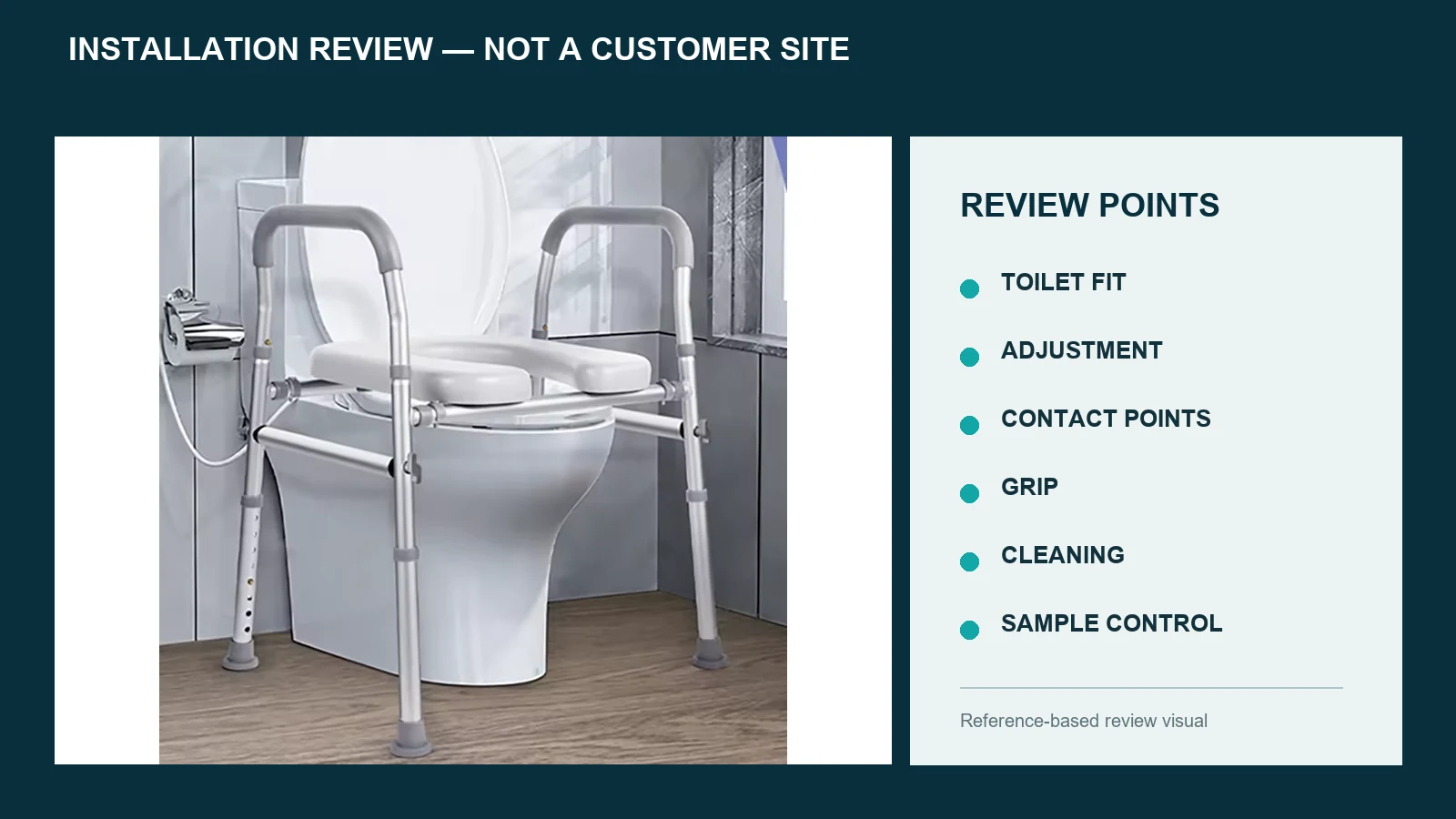
Sample-Approval Workflow
Step 1: Desktop review
Check the drawing, product type, target-toilet data, installation method, material declaration, packaging plan and unresolved assumptions.
Step 2: Incoming inspection
Photograph the carton, label, parts and finish. Compare component quantities and dimensions with the approved documents.
Step 3: Assembly and fit trial
Assemble the rail according to the supplied instructions. Check adjustment, fastener access, alignment and fit around or onto the representative toilet. Record any tools not declared in the instructions.
Step 4: Environment review
Check floor contact, door swing, wall and vanity clearance, approach space, cleaning access and nearby fixtures. Local accessibility or building requirements must be reviewed by the responsible project team; a product sample alone does not prove compliance.
Step 5: Document disposition
List pass, fail and conditional items. Photograph deviations and identify whether a drawing, component, instruction or packaging change is needed. Do not release repeat production until the accepted configuration is clearly identified.
What to Put in the RFQ
Send the manufacturer:
- required rail type and marked reference image;
- target toilet model, dimensions and photographs;
- room and clearance information;
- requested adjustment and installation method;
- grip, foot, bracket and finish requirements;
- destination cleaning method;
- packaging, labelling and instruction language;
- required evidence and tests;
- sample quantity and acceptance checklist;
- destination market and order quantity for feasibility review.
Ask the quotation to list included parts, exclusions, assumptions, open questions and document revisions. Price, MOQ, lead time and stock status must remain quotation-specific.
Limits and Professional Review
Bathroom safety products can involve fall risk, installation risk and accessibility requirements. This article is a procurement framework, not medical, occupational-therapy, engineering or legal advice. The buyer should obtain appropriate professional review for the user population, installation, local codes and complete environment.
Do not claim that a rail prevents falls or fits all users and toilets. Do not infer capacity, certification or compliance from appearance. Evaluate the exact product and installation using verified documents and an approved sample.
Frequently Asked Questions
Is a toilet safety rail the same as a wall grab bar?
No. They may use different structures and interfaces. A toilet safety rail can be freestanding or toilet-mounted, while a wall grab bar depends on wall construction and anchors. Confirm the exact type.
What fit information should a buyer send?
Send the toilet model, dimensions, seat-bolt details when relevant, installation-area photos, floor type, nearby fixtures, door swing and required approach space.
Should a buyer rely on “universal fit” wording?
No. Treat broad fit language as a reason to request the stated envelope and exclusions. Verify the target toilet and room with drawings or a physical sample.
What should be inspected on an adjustable model?
Check every adjustment range, locking feature, left-right consistency, marking, assembly orientation and clearance at the selected settings.
Can CRF customize the product?
CRF supports OEM/ODM feasibility review. Send the target structure, toilet and room data, material or finish requirements, packaging, quantity and destination market for evaluation.
Request a B2B Sample Review
Use the CRF adjustable toilet safety rail product page as a starting reference. Send CRF your target toilet data, installation photos, rail type, adjustment needs, cleaning method, packaging requirements, quantity and destination. CRF can review feasibility and prepare a configuration-specific quotation; final specifications and suitability remain subject to written confirmation, sample approval and the buyer’s professional review.